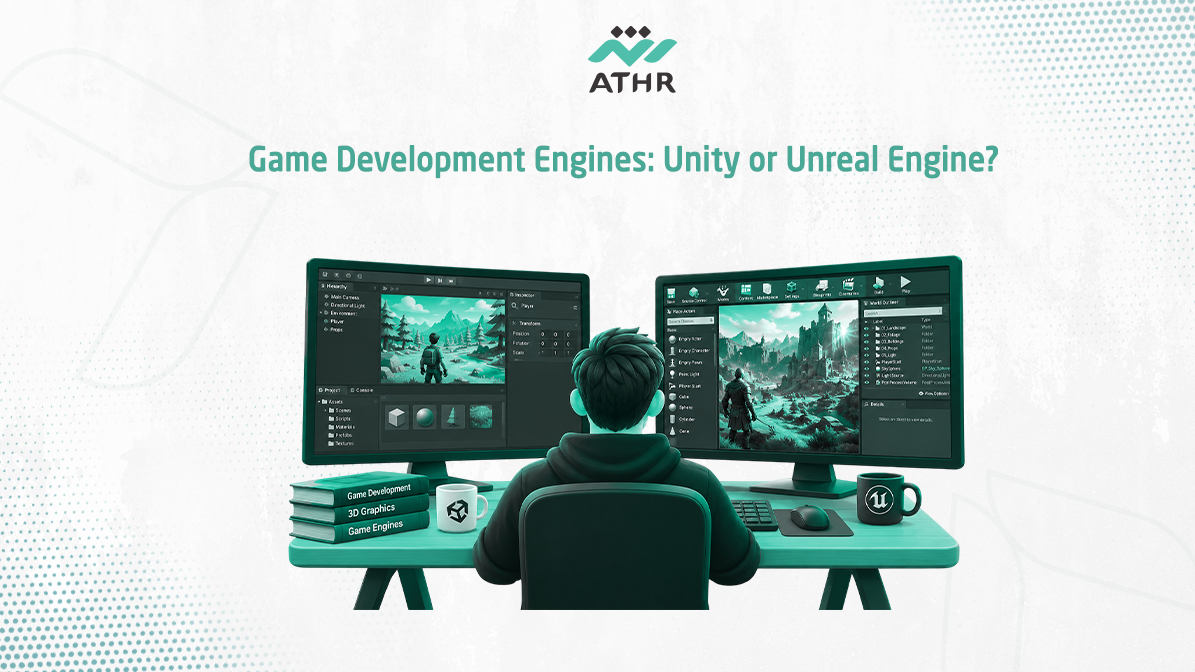
You may have a unique game idea, engaging characters, and enjoyable gameplay, but choosing the wrong game engine can make development more complicated and expensive. That’s why selecting the right game development engines isn’t just a technical decision. It’s an important step that affects graphics quality, game performance, development costs, and compatibility with different devices. Whether you’re considering Unity or Unreal Engine, the best choice is the engine that matches your game idea, budget, and target audience.
Want to know which engine is right for your game? Contact Athr.
What Are Game Development Engines, and How Do They Help You Create Your Game?
Game development engines are software platforms and tools that help developers design and develop video games without building every system from scratch. They provide tools for managing characters, graphics, physics, sound, movement, and interactions between game elements. Choosing the right game development engines helps organize development stages, improve the player experience, and simplify game development and post-launch updates.
What Is a Game Development Engine, and What Role Does It Play in Programming?
A game development engine is the environment that a development team uses to transform a game idea into a playable, interactive experience.
Some of the key functions provided by game development engines include:
- Creating different environments and levels.
- Programming character movement and controls.
- Adding sound effects and visual effects.
- Managing collisions and in-game physics.
- Developing interaction and mission systems.
- Integrating multiplayer systems.
- Testing game performance on target devices.
- Preparing games for release on different platforms.
Having these tools in one environment helps the team develop the project in an organized way instead of building each function separately.
How Do Game Development Engines Affect Graphics Quality and Player Experience?
Game quality doesn’t depend on character design alone. It also involves responsiveness, smooth movement, lighting quality, and how visual elements are displayed.
Choosing the right game development engines helps:
- Improve 3D graphics quality.
- Reduce lag and stuttering during gameplay.
- Optimize memory usage.
- Improve camera and character movement.
- Deliver visual effects suited to target devices.
- Support a stable gaming experience.
However, it’s important to understand that the engine alone doesn’t guarantee good performance. The development team’s expertise, code optimization, and graphics optimization all play essential roles in the final result.
What Are the Most Popular Game Development Engines for Mobile and PC Games?
There are several game development engines, but Unity and Unreal Engine are among the most popular choices for commercial projects.
- Unity: Used to develop 2D and 3D games, offering tools suitable for mobile games, PC games, and several other platforms.
- Unreal Engine: Provides powerful tools for developing 3D games, particularly projects that require detailed environments and realistic graphics.
The choice between them depends on the game type, gameplay mechanics, and required devices, not simply the engine’s popularity.
Explore Athr’s step-by-step guide to Unity game development.
The Difference Between Unity and Unreal Engine in Game Development
The difference between Unity and Unreal Engine lies in their programming tools, graphics capabilities, project organization, and system requirements. Although both engines support different types of games, each offers tools and workflows that may be more suitable for specific projects.
When comparing game development engines, it’s important to focus on your game’s actual requirements rather than assuming one engine is always better.
How Do Graphics Quality and Visual Effects Differ Between Unity and Unreal Engine?
Unreal Engine is known for its advanced lighting and 3D graphics tools, including Lumen for lighting and reflections and Nanite for managing complex geometric details on supported devices. Unity, on the other hand, offers different rendering pipelines that allow developers to choose graphics quality based on the game’s requirements and target devices.
In practical terms, the differences are:
- Unity: Suitable for developing games with simple or advanced graphics, offering flexibility in performance optimization.
- Unreal Engine: Provides powerful built-in tools for creating realistic and detailed environments.
- Both engines: Can deliver professional graphics depending on the team’s expertise, available time, and budget.
Not every game needs the most advanced visual effects, especially when the target audience uses mid-range devices.
What Is the Difference Between Unity and Unreal Engine in Performance and Ease of Programming?
Unity primarily uses C#, while Unreal Engine supports C++ and the Blueprint visual scripting system.
This makes the development process different for each engine.
Comparison Criteria | Unity | Unreal Engine |
Programming Language | C# | C++ and Blueprint |
2D Games | Specialized tools | Supported, but not its primary focus |
3D Games | Supports various levels of complexity | Powerful tools for realistic environments |
Mobile Games | A popular and flexible choice | Suitable with proper performance optimization |
Ease of Learning | A good starting point for many developers | Broader tools that may require more expertise |
Performance | Depends on project optimization | Depends on project optimization |
Final performance isn’t determined by the engine’s name. It depends on the game’s size, scene complexity, code quality, and the specifications of target devices.
Have a game idea and want to turn it into a real project? Contact Athr.
When Is Unity Game Development the Right Choice?
Developing games with Unity is suitable for many projects, particularly those targeting smartphones or requiring flexibility in building levels, characters, and interfaces. The engine provides tools that help development teams create prototypes and test gameplay mechanics before expanding the project.
Why Is Unity Used for Android and iOS Mobile Game Development?
Unity supports game development for Android and iOS, providing tools for handling touch controls, different screen sizes, and resource management.
Some of its most common applications include:
- Puzzle and brain games.
- Racing and drifting games.
- Educational games for children.
- Simulation games.
- 2D and 3D games.
- Multiplayer and online games.
However, mobile game success depends on testing the game on real devices, particularly when the target audience uses mid-range smartphones.
How Does Unity Help Create 2D and 3D Games of Different Complexity Levels?
Unity provides tools for building characters and levels, managing animations, and adding in-game interactions.
It can be used for:
- Designing cartoon or realistic characters.
- Creating multiple maps and levels.
- Programming vehicle and character movement.
- Adding different difficulty levels.
- Building rewards and scoring systems.
- Connecting games to online services.
- Preparing multiple versions for supported platforms.
This helps development teams organize projects according to their size, whether they’re working on a small game or a project requiring multiple development stages.
Discover the essentials of mobile game design and development in our article.
When Should You Choose Unreal Engine for Game Development?
Developing games with Unreal Engine can be suitable for projects that rely on 3D environments and advanced visual details, such as adventure, fighting, simulation, and open-world games. However, choosing Unreal Engine among game development engines should depend on the capabilities of target devices and project requirements, not simply the desire for realistic graphics.
Why Is Unreal Engine Suitable for Realistic 3D Games?
Unreal Engine provides tools for graphics, lighting, materials, and animation, helping developers build highly detailed 3D scenes.
Some of its key capabilities include:
- Designing realistic 3D environments.
- Using advanced lighting systems.
- Creating detailed materials and surfaces.
- Developing character movement and animations.
- Adding various visual effects.
- Managing large and complex scenes.
- Developing interactions using Blueprint or C++.
However, some advanced technologies require higher hardware specifications, and not all features are available at the same level across every device.
How Do Unreal Engine Technologies Support Open-World Game Development?
Open-world games require managing numerous elements, including buildings, vehicles, characters, roads, and missions.
Some of the most important elements required for open-world games include:
- Designing a connected map.
- Distributing buildings and roads.
- Programming non-player character (NPC) movement.
- Managing vehicle movement.
- Creating a mission system.
- Controlling how environmental assets are loaded.
- Optimizing performance when moving between areas.
However, map size alone isn’t enough to determine the right engine. The number of active elements and how they’re programmed have a significant impact on performance.
What Are the Advantages and Disadvantages of Unreal Engine for Small and Large Projects?
One of Unreal Engine’s main advantages is its advanced tools for 3D environments and visual scripting, which can reduce the need to build certain systems from scratch.
However, its challenges include:
- The need for suitable development hardware.
- Time required to learn advanced systems.
- The need to optimize graphics for lower-end devices.
- Managing game file sizes.
- Reviewing licensing terms and royalties.
That’s why it’s better to test your game idea in Unreal Engine before committing to full-scale development.
Turn your game idea into a real project with Athr.
What Is the Best Game Development Engine for Your Project?
The best game development engine isn’t necessarily the one that delivers the highest graphics quality. It’s the engine that suits your game type and the devices your audience uses. That’s why you should compare game development engines based on your project’s requirements before choosing Unity or Unreal Engine.
Is Unity or Unreal Engine Better for Mobile Game Development?
Unity can be suitable for games that require flexibility in level design and performance optimization across a wide range of smartphones. Unreal Engine can also be used to develop 3D mobile games, but it requires greater attention to rendering technologies and graphics optimization, especially on lower-end devices.
Before making your decision, you should determine:
- The game type and gameplay mechanics.
- Minimum smartphone specifications.
- Expected game file size.
- Required graphics quality.
- Target frame rate.
- Number of visible characters and elements.
- Internet connectivity requirements.
These factors help you choose the best game development engine without adding unnecessary features that exceed your project’s needs.
Which Engine Is Suitable for Online and Multiplayer Game Development?
If you’re planning to create an online game, choosing an engine that supports multiplayer functionality isn’t enough. You also need to determine the connection method, number of players, room management, servers, and how movement and data will be synchronized.
Some of the key requirements for online games include:
- Creating game rooms.
- Registering user accounts.
- Synchronizing player movement.
- Managing match results.
- Securing connections and data.
- Reducing gameplay latency.
- Handling internet disconnections.
- Managing servers and scalability.
Both Unity and Unreal Engine can be used to develop multiplayer games, but costs and performance depend heavily on the networking and server infrastructure, not just the game engine.
How do you start developing a 3D game using Unity? Find the answer in our guide.
How Do You Start Your Project with a Professional Game Design Company?
If you have a game idea and want to turn it into a feasible project, the first step isn’t purchasing an engine or requesting character designs. It’s better to define your game’s objectives, audience, and gameplay mechanics before selecting the appropriate game development engines. Working with a specialized company can help you organize development stages and identify technical and financial requirements before programming begins.
What Are the Essential Steps to Turn a Game Idea into a Feasible Project?
To get started in an organized way, you can divide game development into the following steps:
- Define the idea: Determine the game type, objectives, and target audience.
- Analyze requirements: Identify platforms, graphics, and gameplay mechanics.
- Choose the engine: Compare Unity and Unreal Engine based on project requirements.
- Prepare the design: Develop characters, environments, and interfaces.
- Create a prototype: Test the core systems.
- Start programming: Implement the agreed features and levels.
- Test and optimize: Review performance and fix errors.
- Publish and update: Prepare the game for launch and ongoing development.
These steps help establish a clear plan and reduce potential differences between the project owner’s expectations and actual implementation.
How Do You Choose a Game Development Company Experienced in Unity and Unreal Engine?
Choosing a game development company shouldn’t depend on price alone. What matters most is the team’s ability to understand your idea, identify suitable technologies, and explain the development process.
Before signing a contract, review:
- The company’s portfolio and previous projects.
- The team’s experience with game development engines.
- Its ability to develop 2D and 3D games.
- Its expertise in mobile and PC game programming.
- Its approach to testing game performance.
- The clarity of delivery milestones.
- Ownership rights for files and source code.
- Technical support and update services.
Ask the company why it recommends a particular engine for your project, because the answer should be based on your game’s actual requirements.
Why Choose Athr for Game Design and Development?
Because a game’s success doesn’t depend solely on choosing one of the available game development engines, we at Athr focus on understanding the project idea, identifying the target audience, and selecting the right tools for implementation. We combine game design, programming, and performance optimization to deliver a gaming experience that meets each project’s requirements.
How Does Athr Help You Choose the Best Game Development Engine?
At Athr, we begin by studying the project before selecting the appropriate engine, because a mobile racing game doesn’t necessarily require the same technologies as an open-world PC game.
We focus on:
- Identifying the game type and target audience.
- Analyzing devices and operating systems.
- Comparing Unity and Unreal Engine.
- Determining the required graphics quality.
- Reviewing the available budget and timeline.
- Testing core game systems.
- Planning future development and updates.
The goal is to ensure that choosing game development engines is based on the project’s actual needs rather than simply using the latest technologies.
What Game Design and Development Services Does Athr Offer?
Athr provides video game design and development services to help project owners transform their ideas into playable games ready for release.
Our key services include:
- Mobile game design and programming.
- Android and iOS game development.
- PC game design.
- 2D and 3D game development.
- Character and environment design.
- Creating game maps and levels.
- Online and multiplayer game programming.
- Developing mission and reward systems.
- Game UI/UX design.
- Performance optimization and game testing.
- Preparing games for publication on target platforms.
Choosing game development engines isn’t a decision based on the popularity of Unity or Unreal Engine. It depends on the game type, graphics quality, target devices, and available budget. Each engine has advantages and challenges that should be evaluated before development begins. With Athr, you can choose the right engine and start designing and developing your game with a clear plan tailored to your idea and project goals.
Contact Athr today and start turning your idea into an outstanding video game.