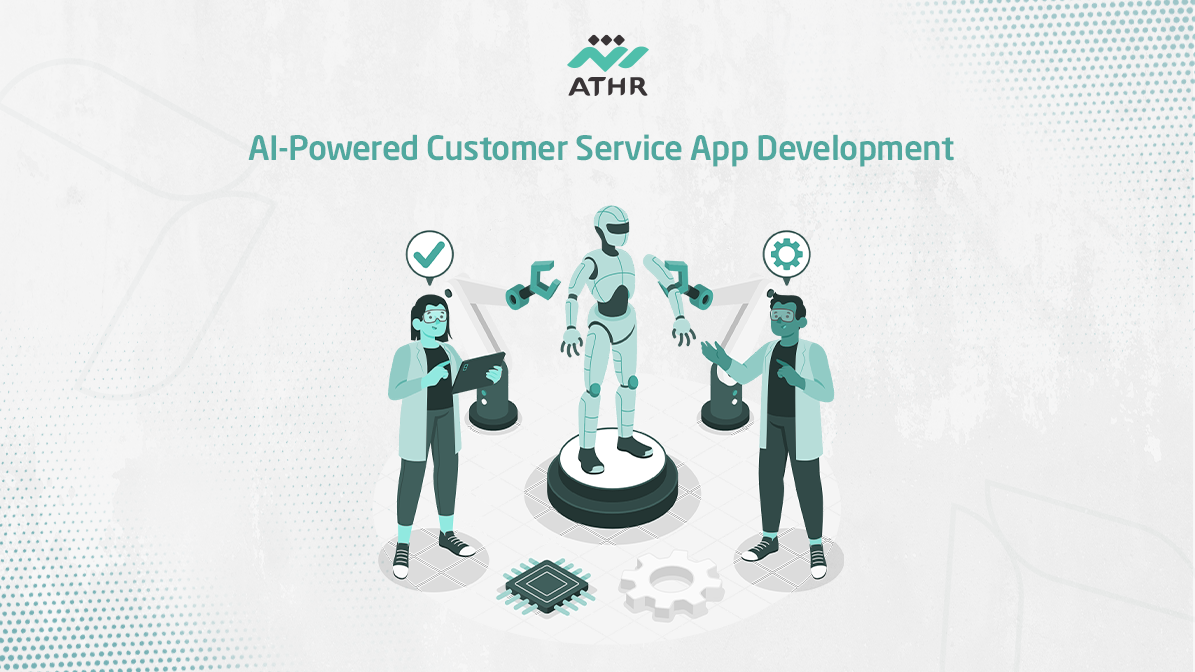
Imagine your customers finding the answers they need within seconds, without waiting or having to repeat the same question. This is what you can achieve through AI App Development for customer service, combining fast responses with seamless conversation management to make communication with your company smoother and more efficient.
Turn every inquiry into an opportunity to earn your customers’ trust! Get started with Athr and request a smart application tailored to your business.
How Does AI App Development Transform Customer Service?
AI app development helps you handle inquiries quickly and provide customers with clear answers without requiring an employee to intervene in every conversation.
The goal is not to replace your customer service team, but to reduce repetitive tasks so employees can focus on resolving complaints and handling cases that require human interaction.
What Tasks Can an AI-Powered App Handle Instead of a Support Agent?
AI-powered customer service automation allows you to manage many daily tasks that consume your team’s time, especially inquiries involving straightforward information or specific procedures within your company’s systems.
Some of the key tasks the application can perform include:
Answering frequently asked questions: Providing information about prices, business hours, shipping policies, and return procedures.
Tracking orders: Updating customers on their order status and the latest shipping information through integration with your store’s system.
Managing bookings: Displaying available appointments and helping customers confirm or modify their reservations.
Handling complaints: Recording issues, categorizing them, and forwarding them to the responsible department.
Recommending products: Suggesting options that match customers’ needs and budgets.
Transferring conversations: Directing complex inquiries to specialized support agents while sharing the previous conversation history.
How Does AI Enable Instant Customer Support Around the Clock?
Developing a virtual assistant for customer support allows your business to receive and respond to inquiries at any time, even outside regular business hours or during public holidays.
When a customer asks about a product or service, the application can search approved information sources and provide an immediate answer without waiting for support agents to return.
To enhance the customer service experience, the application can include the following features:
Arabic language understanding: Interpreting questions written in different styles, including Saudi and Gulf dialects, depending on the AI model’s capabilities.
Personalized responses: Providing answers tailored to customers’ inquiries and data authorized for use.
Multichannel communication: Integrating the AI assistant with WhatsApp, websites, and mobile applications.
Access to company data: Retrieving product details, order information, and booking records from connected systems.
Human support escalation: Transferring cases that require approval or special handling to the appropriate support agent.
When Does Your Business Need an AI-Powered App to Manage Customer Inquiries?
You don’t need to run a large company to benefit from integrating AI into customer service applications. What matters most is identifying a specific problem the application can solve, such as delayed responses, repetitive inquiries, or difficulty managing customer conversations.
Several signs may indicate that it’s time to develop an AI-powered application, including:
Repetitive inquiries: Your team spends a significant portion of the day answering the same questions.
Slow response times: Customers wait too long to receive simple information.
Increasing workloads: The number of conversations rises during promotional campaigns and peak seasons.
Scattered communication channels: Messages arrive through WhatsApp, your website, and your application, making them difficult to manage simultaneously.
Lost sales opportunities: Customers hesitate to complete purchases because they cannot get quick answers.
If you notice more than one of these challenges, an AI-powered application can help you organize customer service operations and reduce the time spent handling repetitive inquiries.
Not every app leaves a lasting impression on its users… Discover how to make your app their first choice!
What Are the Key Features of an AI-Powered Customer Service App?
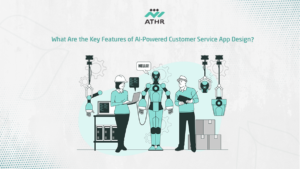
When customers encounter a problem, they want a clear answer and a quick solution, not just an automated response. Therefore, AI-powered customer service app design should focus on simplifying communication, understanding customer inquiries, and helping users complete their requests with as few steps as possible.
To achieve this, your application needs three essential features that make it more valuable to customers and help your team manage conversations efficiently.
Intelligent Responses and Personalized Conversations Based on Customer Needs
Intelligent responses help provide answers that address each customer’s specific question instead of relying on generic messages that fail to meet their actual needs. The application can use conversation context and available information to deliver more accurate responses.
For example, if a customer is searching for a particular product in your online store, the artificial intelligence assistant can recommend suitable options, explain prices and specifications, and answer questions before the customer completes a purchase.
Developing a virtual assistant for customer support also allows you to personalize conversations based on your business activities, with the option to transfer customers to a specialized support agent when additional assistance is needed.
Automated Order Management, Complaint Handling, and Conversation Tracking
You may receive dozens of messages daily through your website, WhatsApp, and mobile application. As your customer base grows, tracking every inquiry and ensuring that each issue is resolved can become an overwhelming task for your support team.
Integrating artificial intelligence into customer service applications helps you centralize and organize these conversations, allowing you to record requests, categorize complaints, and direct each issue to the responsible employee.
Some of the most important features that support this process include:
Automatic complaint classification: Identifying the type of issue, whether it relates to payments, shipping, or service quality.
Conversation tracking: Maintaining communication records so support agents can follow up on issues without asking customers to repeat the details.
Order status tracking: Allowing customers to check the latest updates on their orders through integration with your store’s system.
Follow-up notifications: Alerting employees when an urgent complaint or inquiry requires human intervention.
Arabic Language Support and 24/7 Customer Service
If you’re targeting the Saudi and Gulf markets, it’s important that your application understands how your customers naturally communicate, rather than supporting only Modern Standard Arabic.
For example, when a customer writes (I want to change my appointment) or (What’s the status of my order?), the AI assistant should understand the intended meaning and provide appropriate assistance, even when questions are phrased differently.
To deliver a better experience, make sure your application supports local dialects, provides clear answers, accesses up-to-date company information, and allows customers to connect with a human support agent whenever necessary.
How Is a Virtual Assistant Developed to Respond to Customers?
Developing a virtual assistant for customer support begins with identifying the most common inquiries your business receives, then selecting the appropriate artificial intelligence technologies to understand and respond to them. The goal of AI app development is to provide accurate and fast answers that help customers complete their requests with ease.
The development process involves three essential stages: understanding the customer’s language, connecting the assistant to company information, and enabling communication with human support agents when needed.
Using Natural Language Processing to Understand Customer Inquiries
Natural Language Processing (NLP) technologies help virtual assistants understand questions written in the customer’s own language, even when they are phrased differently. This allows the assistant to identify the intent behind each inquiry and provide an appropriate response instead of relying solely on specific keywords.
For example, if a customer writes (Where is my order?) or (When will my shipment arrive?), the assistant can recognize that the inquiry relates to order tracking and retrieve its status from the system connected to the application.
Training the Virtual Assistant on Company Data and Services
To provide helpful answers, the assistant must have access to accurate information about your business, including services, prices, shipping and return policies, and frequently asked questions.
This can be achieved by connecting the assistant to an updated knowledge base, allowing it to retrieve relevant information whenever a new inquiry is received. This does not necessarily require training a new artificial intelligence model from scratch.
To build an assistant that delivers reliable answers, follow these steps:
Gather company information: Prepare details about products, services, prices, shipping policies, and return procedures.
Create a knowledge base: Organize information into clear sources that the assistant can reference when responding to inquiries.
Test conversations: Use real customer questions to verify that the assistant understands them and provides accurate responses.
Update information: Regularly review company data, especially when prices change or new services are introduced.
Connecting the Artificial Intelligence Assistant with Human Support Agents When Needed
Not every inquiry can be resolved through an automated response. Some issues require reviewing additional details or making decisions that must be handled by a responsible employee, particularly payment complaints, refund requests, and exceptional cases.
Therefore, it’s important to allow customers to transition smoothly from the artificial intelligence assistant to a human support agent without feeling trapped in a conversation that fails to provide a solution.
New opportunities to enhance your customer service in the Saudi market. Discover them in this article.
How Is AI Integrated into Customer Service Applications?
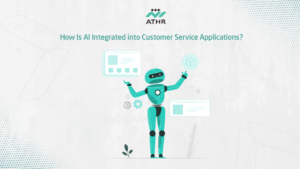
Integrating artificial intelligence into customer service applications allows you to connect an artificial intelligence assistant with your company’s systems, enabling it to provide accurate answers and automate certain tasks. The success of AI app development depends on seamless integration with the tools your business already uses, such as customer relationship management systems, websites, and mobile applications.
The integration process involves connecting data sources, unifying communication channels, and securing customer information to ensure a reliable user experience.
Connecting Customer Service Applications to CRM Systems and Databases
Imagine a customer contacting your company to ask about an order placed last week. Instead of transferring the inquiry to an employee to look up the details, the artificial intelligence assistant can access the order information and provide the latest update after verifying the customer’s identity.
This is achieved by integrating the application with your Customer Relationship Management (CRM) system and internal databases, allowing the assistant to retrieve the information needed to address each inquiry.
When designing an AI-powered customer service application, you can integrate it with several systems, including:
Customer Relationship Management (CRM) systems: Accessing communication history and previous inquiries to provide personalized service tailored to each customer’s needs.
E-commerce databases: Tracking orders and checking product availability and prices.
Booking systems: Displaying available appointments and helping customers make or modify reservations.
Technical support systems: Recording complaints, tracking their status, and forwarding them to the responsible department.
Integration is typically carried out using Application Programming Interfaces (APIs), which allow systems to exchange information in a structured way while controlling which data and actions the assistant is authorized to access.
This enables customers to receive information directly related to their requests without repeatedly explaining the details or waiting for a support agent.
Integrating the Artificial Intelligence Assistant with WhatsApp, Websites, and Mobile Apps
Some customers may prefer contacting your business through WhatsApp, while others choose your website or mobile application. Therefore, it’s important to provide a consistent support experience regardless of the communication channel they use.
By developing a virtual assistant for customer support, you can connect multiple communication channels to a unified system that helps your team track inquiries and organize conversations instead of managing each platform separately.
Protecting Customer Data and Ensuring Conversation Security
When customers ask about their orders or share personal information during a conversation, they expect their data to remain protected and inaccessible to unauthorized individuals.
Therefore, AI-powered customer service automation goes beyond fast responses and automated task execution. It also requires clear data protection measures, especially when handling customers’ personal information and payment details, while complying with the requirements of the Saudi Personal Data Protection Law (PDPL) issued by the relevant authority.
Some of the most important security measures to include in the application are:
Data encryption: Protecting customer information during transmission between the application and connected systems, as well as during storage.
Access control: Allowing the AI assistant and employees to access only the information necessary to perform their assigned tasks.
Customer identity verification: Verifying customer identities before displaying account details or performing sensitive actions, such as modifying personal information.
Conversation record protection: Defining data retention periods, deletion procedures, and permissions for accessing conversation records.
Activity monitoring: Logging access attempts and critical operations to detect unauthorized activity.
Give your customers the experience they’re looking for before they find it with your competitors.
What Is the Difference Between a Traditional Customer Service App and an AI-Powered App?
A traditional customer service application relies on predefined responses and procedures, while AI app development enables businesses to understand customer inquiries and provide more flexible answers based on the context of each conversation.
The difference becomes clear when a customer asks an unexpected question. A traditional system may struggle to understand it, while an AI-powered application can analyze the question, search for a suitable answer, or direct the customer to a support agent when necessary.
Comparing Traditional Chatbots and AI-Powered Virtual Assistants
If a customer simply wants to check business hours or select a service from a menu, a traditional chatbot may be sufficient. It relies on predefined rules and responses and performs tasks it has been programmed to handle.
However, developing an AI-powered virtual assistant for customer support allows you to understand questions phrased in different ways, maintain conversation context, and provide answers tailored to each customer’s needs.
Here are the key differences between the two systems:
| Comparison Factor | Traditional Chatbot | AI-Powered Virtual Assistant |
|---|---|---|
| Understanding inquiries | Relies on specific keywords and predefined rules | Understands various question formats and expressions |
| Response method | Uses predefined responses and templates | Provides answers based on conversation context |
| Complex conversations | Limited to programmed scenarios | Can handle multi-step inquiries within its capabilities |
| Personalization | Requires specific rules for each scenario | Uses conversation context and authorized customer data |
| Information updates | Requires manual updates to responses and rules | Can connect to regularly updated information sources |
| Cost | Generally lower for simple applications | Depends on features, integrations, and usage volume |
Therefore, choosing the right solution depends on the types of inquiries your business receives and whether you need flexible conversations or automated processes.
When Should You Choose a Custom AI Application Instead of Ready-Made Solutions?
You don’t need to build an application from scratch simply because you want to use artificial intelligence in customer service. Several ready-made platforms allow you to configure automated responses, manage conversations, and connect certain communication channels without developing an entire system.
But what if your company offers multiple services or needs to connect the artificial intelligence assistant to internal systems and specific workflows that ready-made platforms don’t support?
This is where custom AI-powered customer service app design becomes valuable. It allows you to build a solution that aligns with your company’s operations while giving you greater control over features, integrations, and user experience.
Custom development may be the right choice for your business in the following situations:
Multiple services: When you need different conversation flows and procedures for each service your company offers.
Integration with company systems: If you want the assistant to connect with CRM, inventory, or booking systems to perform actual tasks.
Data protection requirements: When you need to define access permissions and data retention policies according to your business needs.
Personalized customer experience: If you want to design interfaces and conversations that reflect your brand identity and meet your audience’s needs.
Future scalability: When you plan to introduce new features or serve a larger customer base without relying entirely on the limitations of a ready-made platform.
Before investing in an artificial intelligence application, discover who deserves your trust!
Every customer inquiry is an opportunity to deliver better service. With artificial intelligence app development, you can respond quickly, organize requests, and simplify communication without unnecessary complexity.