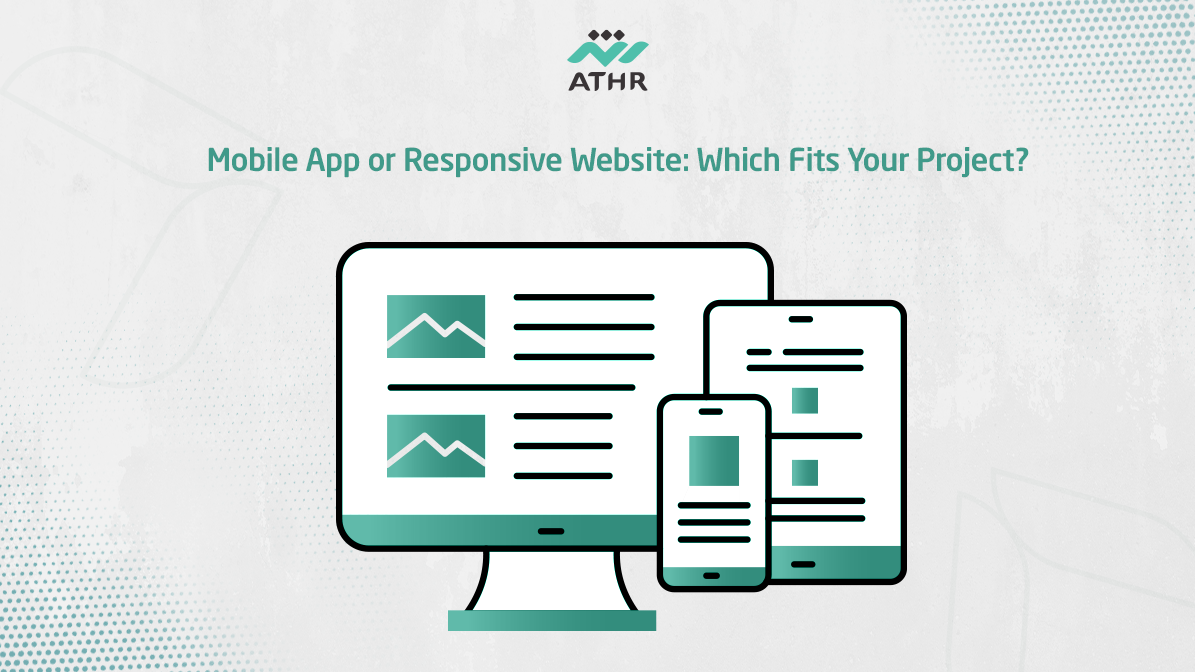
When starting a new digital project, one of the first decisions you’ll face is: mobile app or responsive website? The choice isn’t just a technical decision; it affects how customers reach you, the user experience, development costs, and how easily your project can evolve in the future. Some projects need an app that customers use regularly, while for others, a responsive website provides faster and easier access through Google and from any device.
Choose the right digital solution for your project before you start development.
Mobile App or Responsive Website: What’s the Difference?
The main difference between a mobile app and a responsive website lies in how users access and interact with them. An app is installed on a smartphone and can make greater use of the device’s capabilities, while a responsive website opens directly in a browser and adapts to different screen sizes. That’s why the choice should depend on how customers use your service, not simply on whether your competitors have an app or a website.
What Is a Mobile App and How Does It Work?
A mobile app is a software application developed to run on smartphones and tablets and is usually downloaded from app stores such as Google Play or the App Store.
An app can provide features such as:
- Creating user accounts.
- Sending notifications.
- Using geolocation.
- Accessing the camera.
- Using the microphone.
- Saving user data.
- Processing payments.
- Providing a personalized experience.
- Running certain features without an internet connection.
If customers regularly return to use the service, an app can become an essential part of the project experience.
What Is a Responsive Website and How Does It Work on Mobile Devices?
A responsive website is a website designed so that its layout and elements automatically adapt to the user’s screen size.
This means customers can access it from:
- Smartphones.
- Computers.
- Tablets.
- Different devices and screen sizes.
Without having to download anything.
This makes responsive website design for mobile devices suitable for projects whose main goals are to showcase services and information, receive inquiries, and reach customers through search engines and marketing campaigns.
What Is the Difference Between a Mobile App and a Responsive Website in User Experience?
The user experience differs when comparing a mobile app and a responsive website depending on how users access the service, how frequently they use it, and the features they need.
Factor | Mobile App | Responsive Website |
Access | Requires download and installation | Opens directly in the browser |
Frequent Use | Easier and faster | Suitable for quick visits |
Personalization | Greater | Relatively limited |
Device Features | Supports them more extensively | Relatively limited |
Notifications | Supports push notifications | More limited capabilities |
User Experience | Suitable for continuous engagement | Suitable for quick access |
Read more about the importance of user experience in mobile apps.
How Do You Choose Between an App and a Website?
Choosing between a mobile app and a responsive website starts with the nature of the project itself. There’s no single solution that works for every business. An e-commerce store is different from a delivery platform, and a consulting company website is different from a fitness or booking app.
Which Project Goals Determine the Right Choice?
Before starting development, define exactly what you want your digital solution to achieve.
Is your goal to:
- Showcase the company’s services?
- Generate customer inquiries?
- Sell products?
- Receive bookings?
- Provide a daily service?
- Track orders?
- Build a user community?
- Send notifications to customers?
- Provide a personalized experience for each user?
Answering these questions helps you determine whether a mobile app or responsive website is the better fit for your goals.
How Does Your Target Audience Affect the Choice Between an App and a Website?
Not every audience uses digital services in the same way. If users only need the service once or twice, requiring them to download an app may add an unnecessary step.
But if the service is a regular part of their daily routine, such as:
- A delivery app.
- A fitness app.
- An educational platform.
- A financial app.
- A frequently used store.
- A recurring booking app.
- A communication platform.
Having an app on their smartphone can make the service easier to use and increase the chances of them returning.
When Is a Responsive Website Enough for Your Project?
A responsive website can be sufficient if the main goal is to introduce customers to your business or services, attract traffic from Google, and receive customer inquiries.
For example:
- Service companies.
- Consulting firms.
- Real estate companies.
- Informational medical websites.
- Corporate websites.
- Blogs.
- Service pages.
- Marketing websites.
The important thing is that the website itself is fast, organized, clear, and properly designed for mobile devices.
Not sure whether to start with an app or a website? Start by defining the customer journey.
When Is Mobile App Development for Businesses the Right Choice?
Mobile app development for businesses makes sense when the app itself is part of delivering the service, rather than simply being another version of the website. If users need to access it regularly, track data, receive notifications, or use smartphone features, an app can provide greater value.
Which Projects Need a Custom Mobile App?
Some types of projects are naturally more suited to mobile apps, such as:
- Delivery apps.
- Transportation apps.
- Fitness and health apps.
- Educational platforms.
- Electronic games.
- Loyalty and rewards apps.
- Financial apps.
- On-demand service platforms.
- Communication and community apps.
- Order tracking systems.
But even in these cases, the project should be analyzed before making a decision.
How Does an App Help Increase Customer Engagement and Loyalty?
One advantage of an app is that it stays on the user’s smartphone, allowing the project to create a more continuous experience.
You can use the app to:
- Send important notifications.
- Provide personalized offers.
- Save user preferences.
- Speed up ordering processes.
- Display transaction history.
- Create loyalty programs.
- Personalize content.
- Make it easier to return to the service.
This makes apps suitable for projects whose success depends on frequent use.
When Do You Need Features That a Responsive Website Cannot Provide?
Modern websites can perform many functions, but apps generally offer broader and smoother integration with device features.
You may need an app if your project relies heavily on:
- GPS.
- Camera.
- Microphone.
- Push notifications.
- Bluetooth.
- Device features.
- Background processes.
- Local data storage.
- Offline functionality for certain features.
Here, the comparison between a mobile app and a responsive website should be based on the actual functions required.
Explore the article and discover the latest mobile app development solutions.
When Is a Responsive Website Better?
Responsive website design for mobile devices can be the simpler and more practical choice when the goal is to reach as many users as possible without requiring them to download an app. Users can reach the website through search, an advertisement, or a social media link and open the page directly.
Why Is a Responsive Website Suitable for Projects That Want to Rank on Google?
If your project’s strategy relies heavily on SEO, a website provides pages that search engines can discover, understand, and rank in search results.
You can create pages for:
- Services.
- Products.
- Categories.
- Cities and locations.
- Articles.
- Frequently asked questions.
- Case studies.
As a result, the website can become a key source of new organic traffic.
How Does a Responsive Website Make It Easier for Customers to Access Your Services?
The biggest advantage here is reducing the number of steps. A customer can see an ad or search result, click it, and within seconds be on the service page.
There’s no need for:
Download ← Install ← Open the app ← Create an account before discovering the service.
This is especially important for customers interacting with the business for the first time.
Contact Athr today and discover which solution best fits your idea.
What Factors Matter Before Choosing an App or Website for Your Project?
Before making a decision, don’t start with technology. Start with the needs of the business and its users. At Athr, project analysis begins with understanding the service, audience, user journey, and required functions, then determining the most suitable technical solution.
How Do Project Size and Budget Affect the Choice?
The larger the project and the more features required, the more development time, testing, and cost will increase.
Consider:
- Available budget.
- Size of the first release.
- Expected number of users.
- Essential features.
- Required integrations.
- Operating costs.
- Support and maintenance.
- Future scalability.
You can start with a simpler solution and expand after confirming market demand.
What Features Does the User Actually Need?
One common mistake is adding features because they look advanced, not because customers actually need them.
Ask:
- What is the core function?
- What is the minimum number of features needed to deliver real value?
- Which features can be postponed?
- Which features will users use regularly?
- Defining this helps prevent unnecessary project complexity and costs.
Learn about the key elements of a website that reflects your company’s identity.
What Is the Cost Difference Between a Mobile App and a Responsive Website?
When comparing the cost of a mobile app or responsive website, a responsive website is generally simpler to develop for informational and service-based projects, while app development costs can increase as the number of screens, functions, and integrations grows.
However, the final price is determined by the project scope, not simply by the type of solution.
What Factors Determine the Cost of Mobile App Development for Businesses?
App development costs can be affected by:
- Number of screens.
- UI/UX design.
- Android and iOS.
- Admin dashboard.
- Server and database.
- User accounts.
- Notifications.
- Maps.
- Payment gateways.
- APIs.
- Chat functionality.
- Image and file uploads.
- Security level.
- Testing.
- App store publishing.
That’s why an accurate development cost cannot be determined from a general idea alone.
How Much Does Project Size Affect the Cost of Responsive Website Design for Mobile Devices?
The same principle applies to websites. A simple corporate website is completely different from an online store, booking platform, or advanced real estate website.
The cost is affected by:
- Number of pages.
- Design level.
- Custom development.
- Admin dashboard.
- Languages.
- Forms.
- Databases.
- Integrations.
- Payment gateways.
- Booking systems.
- Custom features.
The more requirements a project has, the more design, development, and testing stages it will require.
Which Requires Higher Maintenance and Update Costs?
An app may require more ongoing attention because it needs to work with different operating systems, app stores, and software versions, in addition to the server and admin dashboard if they are included.
A website also requires:
- Updates.
- Security.
- Backups.
- Performance monitoring.
- Content updates.
- Integration maintenance.
That’s why you shouldn’t compare a mobile app and a responsive website based only on development costs; you should also consider operating, maintenance, and scaling costs.
Why Choose Athr to Develop a Mobile App or Responsive Website?
At Athr, we believe the right decision isn’t that every project must have an app, nor that a website is enough for every business. The decision should start with understanding the business model, users, and the functions the project actually needs. That’s why we provide mobile app development and responsive website design solutions based on the nature of each project.
Experience in Mobile App Development and Responsive Website Design
Project development doesn’t stop at the appearance of the interface.
At Athr, we focus on different stages, including:
- Project analysis.
- User experience planning.
- UI/UX design.
- Mobile app development.
- Responsive website design.
- Backend development.
- Databases.
- Admin dashboards.
- APIs and integrations.
- Testing.
- Preparing the project for launch.
- Future support and development.
The goal is to build a digital solution that is usable and scalable, not simply an interface that looks good.
Technical Support That Helps Your Project Grow and Scale
Your project’s needs one year from now may be completely different from what they were on launch day. You might start with a website and later need an app, or start with an app and later need a marketing website and an integrated management platform.
In the future, you may also need:
- New payment gateways.
- Additional languages.
- Subscription systems.
- CRM.
- ERP.
- New branches.
- Artificial intelligence features.
- Loyalty systems.
- Advanced reports.
- External integrations.
Whether your project needs a mobile app or responsive website, real success isn’t just about choosing the platform. It’s about building a fast and easy experience that helps users achieve their goals and supports your project’s growth. With Athr, you can start from planning and design and continue through development, launch, and scaling.