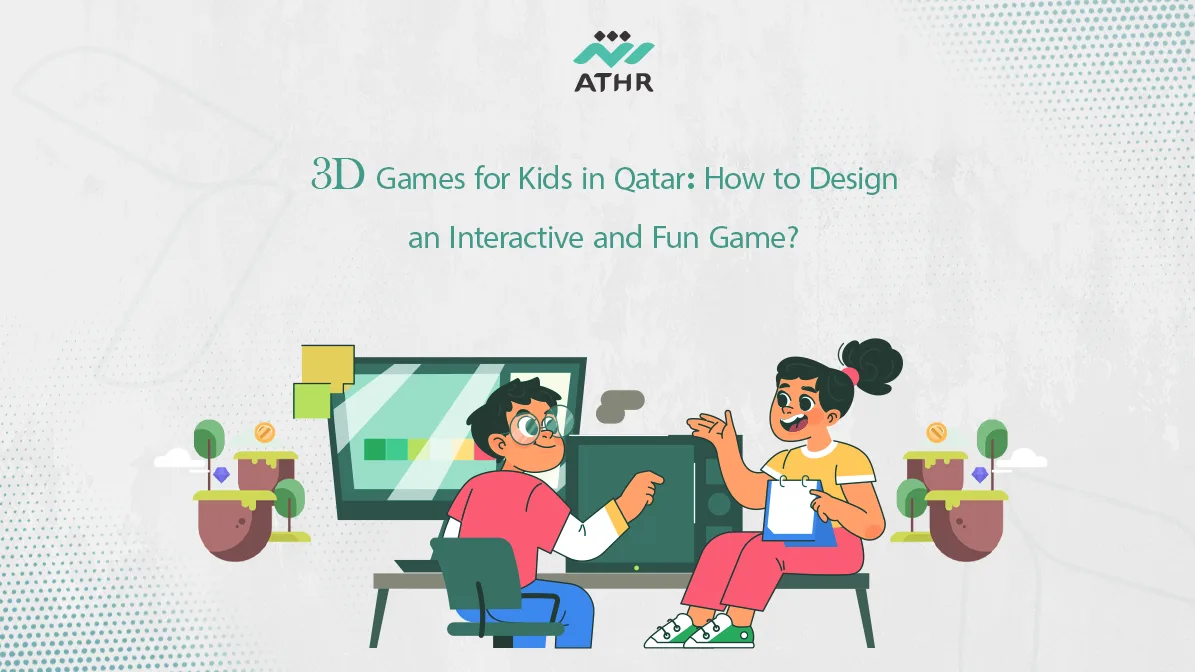
Designing 3D games for kids in Qatar is no longer just entertainment; it is a smart educational tool that develops skills and fosters a love for learning through play. If you’re looking for a game that combines fun with educational value, while being culturally appropriate for Qatari children, you’re in the right place. In this guide, we’ll show you how to design an engaging interactive game with practical steps, modern standards, and professional expertise provided by Athr for Digital Marketing and Programming.
We are here to turn your ideas into interactive 3D games!📞 Contact us now.
Programming Educational Games for Kids in Qatar According to Modern Standards
Designing 3D games for kids in Qatar requires a thorough understanding of the child’s needs, consideration of local values, and the application of global standards in user experience (UX) and digital safety. The goal is to create a game that teaches the child without them feeling it, motivating them to keep playing.
🥽 Why Are Educational 3D Games the Best Choice for Kids?
- Interactive Learning: Children learn by doing, not just receiving information.
- Sensory Stimulation: 3D graphics and engaging sound effects.
- Skill Development: Logical thinking, focus, and problem-solving.
- Cultural Compatibility: Content suitable for the Qatari and Arab environment.
Best Programming Languages and Technologies for Kids’ Games
Choosing the right technology directly affects performance, ease of development, and scalability. Below are the most effective options for 3D games for kids in Qatar:
🎮 Game Engines
- Unity 3D: Ideal for children’s games, lightweight, fast, and supports customization.
- Unreal Engine: Advanced graphics for high-detail games.
🧩 Programming Languages
- C#: The most common language with Unity for stable performance.
- C++: For higher performance in complex games.
⚙️ Supporting Technologies
- Artificial Intelligence (AI): To customize challenges according to the child’s level.
- Parental Control Systems: To protect content and manage screen time.
- Cross-Platform Support: For both Android and iOS.
- Integrating Educational Content Within the Gaming Experience
The success of designing 3D games for kids in Qatar depends on seamlessly integrating education into the play experience without compromising fun.
How Do We Integrate Learning Smartly?
- Learning Through Missions
Each level teaches a skill: numbers, colors, letters, or positive behaviors. - Smart Rewards
Points, badges, and characters unlocked upon completing educational tasks. - Interactive Stories
A short story that encourages the child to think and make decisions. - Tracking Progress
Progress boards show the child’s development and motivate continued play.
💬 We Value Your Inquiry… Get in Touch with Us!
How to Balance Entertainment and Education When Designing Children’s Games?
The biggest challenge in developing safe and engaging children’s games is offering educational content that is beneficial without making the child feel bored or forced. The right balance ensures that the game is fun first, and education becomes a natural part of the experience.
To achieve this balance, the game must be built on:
- A simple and smooth gameplay experience suitable for the child’s age.
- Clear educational goals that are not too obvious.
- Motivational rewards that encourage the child to progress.
This approach is what makes 3D games for kids in Qatar an effective educational tool, rather than just an entertainment medium.
Integrating Educational Content Without Boredom
Programming educational games for children in Qatar relies on seamlessly integrating education into play, allowing the child to absorb information while having fun, without feeling bored.
Best Proven Methods:
✔️ Learning Through Tasks: Each level carries a simple educational objective.
✔️ Trial and Error: Allowing the child to explore without immediate punishment.
✔️ Gradual Difficulty: Increasing challenges as the child progresses.
✔️ Visual and Audio Interaction: Comfortable colors, encouraging sounds, and clear movements.
This approach is widely used in developing safe and engaging children’s games because it helps maintain the child’s focus for extended periods.
Examples of Successful Educational Games
To understand the market practically, let’s look at examples that have proven successful in the 3D children’s game market in Qatar and similar markets:
🔢 Games for Learning Numbers and Letters
- Featuring 3D cartoon characters.
- Suitable for children aged 4–7 years.
🧮 Problem-Solving Games
- Short levels focusing on thinking and organization.
- Develops skills in concentration and decision-making.
🎮 Simple Simulation Games
- Such as managing a farm or a small town.
- Teaches responsibility and planning.
These models confirm that designing children’s games can achieve both educational and commercial success at the same time.
🕹️ Practical Information to Help You Make a Smart Decision Without Risk
Step-by-Step Guide to Designing 3D Games for Children
Designing 3D games for children requires following specific steps to ensure the quality of the game and an enjoyable user experience. Let’s break down each stage:
Stage 1: Concept and Age Group Analysis
Before you start designing an interactive game for children, it’s essential to understand your target audience:
- Define the age group to ensure content suitability.
- Study their interests and preferred playing styles.
- Define the game’s objectives: educational, entertaining, or both.
💡 If the game is aimed at children aged 5 to 7 years, it’s best to use colorful graphics, simple cartoon characters, and short tasks to encourage focus.
Stage 2: Designing 3D Characters and Environment
The most critical stage in designing 3D children’s games is creating appealing characters and environments:
- Design characters in a fun, colorful way with clear expressions.
- Build a 3D environment that is safe and age-appropriate.
- Use sound effects and animations to encourage interaction.
Choose reliable design tools such as Unity or Unreal Engine, which provide powerful options for creating high-quality educational and interactive games.
Stage 3: Game Testing Before Launch
No game should be launched without testing to ensure its quality and ease of play:
- Collect feedback from children and direct user experience.
- Ensure that educational tasks are clear and easy to understand.
- Gradually adjust difficulty levels to suit all player levels.
Why Choose Athr for Developing a 3D Children’s Game in Qatar?
When executing all these stages professionally, you need a partner who understands both technology and children. Here’s where Athr’s expertise in designing 3D games for children comes into play, offering:
- Thoughtful planning for each stage.
- Professional 3D design suitable for children.
- Safe and scalable programming.
- Practical experience that supports E-E-A-T standards.
📨 Contact Athr’s team and start working on designing your game now!
What Is the Ideal Age Group for Different Types of 3D Games for Kids?
When designing 3D games for kids in Qatar, it’s crucial to consider the target age group. Each age group requires a different type of game with varying levels of difficulty and content suited to their abilities.
3D Games for Kids Aged 3–6 Years
For this age group, the focus should be on games that allow children to explore 3D environments in the simplest ways. The games at this stage should be fun, filled with bright colors, and feature easily understandable cartoon characters.
✔️ Key Points:
- Simple Interface: The game should be easy for children in this age group to use.
- Low-Difficulty Interactive Activities: Such as dragging and dropping or pressing buttons to move objects.
- Educational and Motivational: These games can enhance children’s motor and cognitive skills through interactive activities.
🕹️ You can design a game that allows children to interact with cartoon characters in a virtual environment, like a park where they can learn colors, numbers, and shapes.
Interactive Games for Kids Aged 7–12 Years
At this age, children can handle more challenging games that blend education and entertainment. These games can be more complex, with various levels and challenges that gradually increase in difficulty.
Key Points:
- Balanced Difficulty Level: The game should be full of challenges but not frustrating.
- Educational and Interactive: The game should include educational elements such as puzzles or games that foster critical thinking.
- Competitive Elements: Group or individual tasks can be introduced to increase player interaction.
💡 Get valuable tips on developing children’s games in Dubai from Athr!
How Do 3D Games Affect Kids’ Cognitive and Behavioral Skills?
3D games are among the most important tools that help develop children’s skills, as they can significantly enhance their cognitive and behavioral abilities. These games, with their blend of realism and imagination, are a powerful motivator for children to explore their skills in areas such as critical thinking, analysis, and problem-solving.
Enhancing Creative Thinking and Problem-Solving
When playing 3D games, children are required to use their imagination to overcome challenges, which enhances creative thinking. They can solve puzzles, overcome obstacles, and interact with elements in the game in a way that encourages them to develop new strategies. Through this interaction, children learn how to think outside the box, an essential life skill.
Improving Focus and Interaction in Children
By continuously interacting with the game and its tasks, 3D games help improve children’s ability to focus for extended periods. 3D games require deep concentration, whether in solving puzzles or making quick decisions during gameplay. This type of interaction increases the child’s ability to focus in various aspects of their life, benefiting their performance at school or in daily activities.
📞 Contact us for any inquiries or assistance. We’re here to help!
Is There a Difference Between 3D and 2D Games for Kids?
There are significant differences between 3D and 2D games in terms of interaction and experience. These differences directly affect how children interact with the game and influence its appeal and effectiveness in stimulating both education and fun. In this section, we will compare 3D and 2D games in terms of interaction and how they engage children in Qatar.
Comparison Between 3D and 2D Games in Terms of Interaction
| Criterion | 3D Games | 2D Games |
| Graphics and Design | Complex graphics and 3D dimensions that mimic reality more closely | Flat graphics with fixed dimensions showing limited depth |
| Interaction | Provides an immersive interactive environment where children can interact with different dimensions and directions | Interaction is limited to two dimensions, making the experience less varied |
| Realism | Offers a near-real experience with kinetic effects like movement in space | Light and simple experience without interaction with the environment in 3D |
| Learning and Mental Development | Stimulates children to think spatially and develop skills in navigation and interaction with complex environments | Focuses on simple learning that enhances hand-eye coordination skills |
| Cost | Usually more expensive to develop, requiring advanced technologies | Cheaper to develop and requires fewer resources |
Which Is More Engaging for Kids in Qatar: 3D or 2D?
When we talk about the most popular games among children in Qatar, 3D games come out on top. Due to the interactive and realistic nature these games offer, they can capture children’s attention for longer periods, providing a more exciting gameplay experience.
If you’re running an educational project or institution looking for an innovative way to engage children, investing in designing 3D games for kids in Qatar is a strategic choice. With Athr, you can launch a professional 3D game that reflects your vision and provides long-term educational value.
Get ready to design your 3D game with our specialized team! 📨 Contact us to start the project.