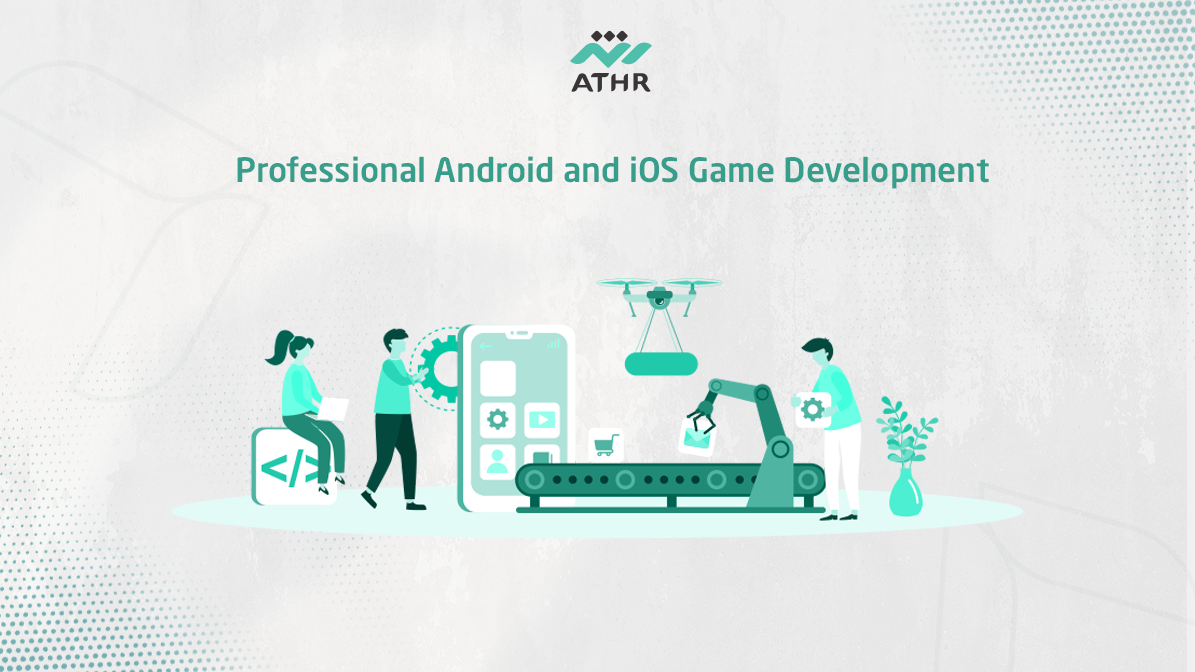
A successful mobile game starts with a powerful idea and a user experience that engages players from the very first moment. That’s why Athr provides professional Android and iOS game development services, combining attractive design, fast performance, and precise programming to turn your idea into a launch-ready game.
📞 Our team is with you from start to finish… Contact us now!
What Is the Best Way to Design Professional Mobile Games?
The best way to design professional mobile games is to start with the player experience itself. The game should be easy to understand from the very first moment, with clear buttons, enjoyable levels, and a smooth experience across Android and iOS devices.
At Athr, we develop mobile games as a complete product that starts with studying the idea and designing the gameplay experience, then moves through UI design, programming, and testing until the game reaches users with professional quality and an enjoyable experience.
Designing User-Friendly Interfaces for Mobile Screens
The game interface is the first thing the player interacts with, so it must be clear, simple, and easy to use from the very first moment.
When developing Android and iOS games, it is important to consider different screen sizes, button placement, touch controls, and the natural movement of the player’s hand during gameplay to ensure a comfortable and smooth experience across different devices.
🔹 Make Control Buttons Clear and Easy to Reach
In mobile games, players rely on their fingers to control the game, so movement, jump, and action buttons should be placed in accessible and comfortable positions.
Make sure the main buttons are large and clear, and avoid placing important elements in areas that are difficult to reach.
🔹 Design the Interface According to the Game Type
Every game needs an interface that matches its nature. Educational games require a clear and simple design, action games need fast-access buttons and direct effects, while children’s games require large icons and attractive colors.
Building an Enjoyable Gameplay Experience That Reduces Boredom and Increases Engagement
When developing Android and iOS games, the focus should be on creating a gameplay experience that encourages players to continue. This can be achieved through clear levels, gradual challenges, rewards, achievements, and daily missions that make every step inside the game feel valuable.
If the game is boring or unclear, users will quickly leave and may not return.
🔹 Start Simple, Then Increase the Challenge Gradually
The game can begin with a simple tutorial level, then introduce a new challenge, followed by stronger obstacles, along with rewards that motivate players to keep going.
This approach helps reduce boredom and increases the time users spend inside the game.
🔹 Use Smart Rewards That Encourage Players
Daily rewards, weekly challenges, and in-game achievements make users feel that there is always something worth coming back for.
Rewards are not limited to points only. They can include a new character, an extra level, a helpful tool, an achievement badge, or a higher ranking among players.
The Importance of Visual and Audio Effects in Improving Game Quality
Visual and audio effects are important elements that make the player feel the game is enjoyable. The sound of winning, jumping animations, reward collection effects, and transitions between levels are all small details that create a better gameplay experience and increase the player’s connection to the game.
Effects should be used smartly because too many heavy effects may slow down the game and drain the device battery.
🔹 Visual Effects Make the Game More Dynamic
A game without movement or visual interaction may feel boring. Visual effects help players understand what is happening inside the game more clearly.
Examples include a flash effect when winning, a simple animation when pressing buttons, an effect when collecting coins, smooth transitions between levels, and a clear effect when losing an attempt.
🔹 Sound Increases Player Immersion
Good sound makes the gameplay experience more interactive. Intro music, reward sounds, error sounds, and level transition sounds all help players remember the game and build a stronger connection with it.
To make sound effective, it should be clear and not annoying, with the option to mute it and customize different sounds for important in-game events.
🔗 Click to explore the mobile game design guide in the UAE.
Mobile Game Development Stages Step by Step
Mobile game development goes through a set of organized stages, starting with understanding the game idea and target audience, then designing the game visuals and gameplay experience, followed by programming, testing, and final preparation for publishing.
It is not recommended to start programming directly without a clear plan, because every stage affects the game’s quality, performance, and overall player experience.
1️⃣ Planning and Building the Game Concept
Before starting, it is important to define the type of game, the target audience, the gameplay style, and whether the game will be educational, entertainment-based, competitive, or multiplayer. The clearer the idea is, the faster and more professional the development process becomes.
What Does the Game Concept Include?
The game concept includes several important details, such as the core idea, target age group, gameplay style, number of levels, points and rewards system, characters, worlds, monetization methods, and target platforms such as Android and iOS.
At Athr, we begin by analyzing the idea, then create a practical gameplay concept. After that, we define the most suitable technologies, whether Unity, Flutter, or custom development, depending on the nature of the project.
2️⃣ Character Design and Gameplay Experience Stage
This is the stage where the game idea starts turning into a real visual experience that players can see and interact with. During this phase, characters, backgrounds, buttons, menus, screens, and gameplay flow are designed in a way that makes the experience simple and enjoyable.
🔹 Character Design in Android and iOS Games
Characters are an essential part of the game’s identity. The clearer, more suitable, and more memorable the character is, the stronger the player’s connection with the game becomes. That is why characters should match the users’ age group, reflect the nature of the game, appear clearly on small screens, and be scalable for future upgrades such as new skills or different looks.
🔹 Gameplay Experience
Gameplay experience is the most important factor in a game’s success. If players feel enjoyment and progress from the first minute, they are more likely to continue playing and return again. That is why it is better to start with an easy level, then gradually increase the difficulty, while providing clear rewards, short instructions, and simple screens that do not delay the player before starting the game.
3️⃣ Programming, Testing, and Optimization Stage
At this stage, the gameplay mechanics are built, including character movement, win and loss rules, points system, login, ads, subscriptions, notifications, and leaderboards, depending on the type of game.
This is where choosing an experienced Android and iOS game development company becomes essential, because any programming or performance issue can affect the player experience, reduce game ratings, and limit its chances of success after launch.
🔹 Testing the Game Before Launch
Testing the game before launch is a key step to make sure everything works properly. A game may run smoothly on a modern device but face problems on a mid-range device or a different screen size.
🔹 Optimizing Performance Before Publishing
Performance optimization is what makes the game faster and more stable. It includes compressing images and files, reducing unnecessary effects, improving code quality, lowering memory usage, testing the game on multiple devices, and adjusting graphics quality according to each device’s capabilities.
📝 Learn how to create Android and iOS games with quality that meets market expectations.
4️⃣ Publishing on Google Play and the App Store
After completing the design, programming, and testing stages, the publishing phase begins. This stage requires careful preparation because app stores do not only review the game file; they also consider quality, description, screenshots, age rating, privacy, and performance.
Google Play explains that building a high-quality game requires improving content, user experience, and technical performance to achieve long-term success.
✔️ Preparing the Game for Publishing on Google Play
To publish on Google Play, you need to prepare the game name, a short and clear description, an attractive icon, in-game screenshots, a privacy policy, an age rating, and the app file, whether APK or AAB. It is also recommended to test the game internally before releasing it to the public to make sure it runs smoothly and reliably.
✔️ Preparing the Game for Publishing on the App Store
Publishing on the App Store requires following Apple’s standards in terms of performance quality, data clarity, privacy, screenshots, and user experience across iPhone and iPad devices.
💬 Request a free consultation to develop a professional Android and iOS game.
How Long Does Android and iOS Game Development Take?
The duration of Android and iOS game development varies depending on the game’s size, type, number of levels, graphics quality, and gameplay mechanics.
Simple games may have a prototype ready within a few weeks, while 3D or multiplayer games usually require more time due to design, programming, testing, and performance optimization.
Factors That Determine the Timeline for Android and iOS Game Development
The development timeline for a mobile game is affected by the size of the idea, the level of design, and the number of required features inside the game. The clearer the details are from the beginning, the faster and more organized the development process becomes.
1) Game Concept Size
A clear and well-defined idea helps the development team understand the requirements and execute them without delays. However, changing the idea during development may lead to redesigning or modifying entire stages. That is why it is important to define the game type, target audience, number of levels, and whether it will be launched on Android only or on both Android and iOS.
2) Design Level
Professional mobile game design includes ease of use, clear buttons, smooth motion, and an enjoyable gameplay experience from the very first moment. The more characters, worlds, effects, and animations the game includes, the longer the development process may take.
3) Programming and Internal Systems
Android and iOS game programming may include user registration, progress saving, points and rewards, subscriptions, in-app purchases, ads, notifications, and a dashboard for managing content. Each additional feature requires time for development and testing to ensure the game is stable and professional.
The Difference Between a Simple 2D Game and an Advanced 3D Game in Android and iOS Development
The difference between a 2D game and a 3D game is not limited to visuals only. It also includes development time, production cost, team size, and performance testing.
| Comparison | Simple 2D Game | Advanced 3D Game |
|---|---|---|
| Design | Flat and simple graphics | 3D characters and environments |
| Cost | Lower cost | Higher cost |
| Development Time | Faster to develop | Requires more time |
| Performance | Works on most devices | Requires strong optimization |
| Best For | Education, children, puzzles | Simulation, adventure, realistic games |
| Experience | Simple and fast | More realistic and interactive |
📍 If you want to launch your idea quickly and test the market, choosing a 2D game is the most suitable option. However, if you need a stronger visual experience and higher interaction, a 3D game may be better, but it requires more time and a higher budget.
How Does Good Planning Help Speed Up Android and iOS Game Development?
Good planning helps you launch the game faster and with fewer problems. Many game projects are delayed because the idea is unclear, requirements change during development, or major issues are discovered too late.
Start with a Clear Game Concept Document
Before starting Android and iOS game development, it is important to prepare a simple document that explains the game idea, target audience, gameplay style, number of levels in the first version, required platforms, monetization method, design style, and the core features that should be developed first.
Rely on an Initial MVP Version
It is better to start with a simple MVP version that includes only the most important features, such as one or two levels, a clear points system, an easy interface, and a basic gameplay experience. After launch, the game can be improved based on player interaction and real user needs.
Test the Game on Real Devices
The game should be tested on real devices because performance may vary from one device to another depending on the processor, screen, memory, and operating system. Early testing helps improve speed, reduce battery consumption, and ensure a smoother gameplay experience.
Prepare for Publishing Early
Publishing preparation should not be left until the last moment. It is better to prepare store accounts, privacy policy, game description, screenshots, and promotional video early, so the launch is not delayed due to store reviews or required changes.
📌 At Athr, we include the publishing plan as part of the mobile game development stages from the beginning, so launch does not become a sudden step at the end of the project.
✉️ Our team is ready to help you. Send us your message now.
Android and iOS game development is an important step in turning your idea into an enjoyable experience that players can use easily. With good planning, attractive design, and strong programming, your game can become ready for success.
📨 Contact Athr now and start developing your game professionally.