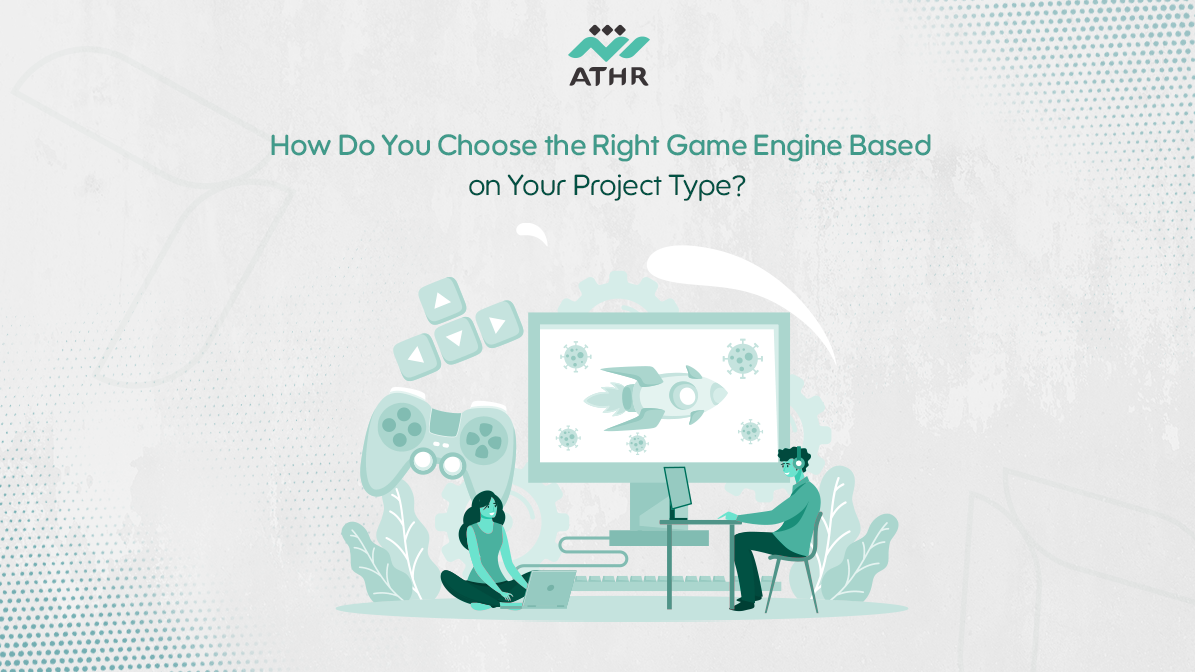
Before you start designing your game, you need to know which game engine best fits your idea. The right choice helps you build your game with better quality, less time, and a clearer development cost.
📞 Contact Athr today, and let our team help you choose the right game engine.
What Are the Key Factors to Consider Before Choosing a Game Development Technology?
Before choosing between Unity, Unreal, or any other game engine, you need to ask yourself a few important questions: What type of game are you building? Who is your target audience? Where will the game be published? And what is your available budget?
These questions help you choose the right game engine for your project, instead of choosing a popular engine that may not fit your game idea or business goals.
1️⃣ Game Type and Target Audience
The type of game is the first factor to consider. For example, an educational game for children is completely different from a 3D racing game, a simple puzzle game, or a multiplayer game.
If the game is designed for children, you need a simple experience, attractive colors, and stable performance. But if it targets professional gamers, you may need high-quality graphics, realistic movement, and more detailed gameplay mechanics.
2️⃣ Required Platform: Android, iOS, PC, or Web?
The platform where your game will be published has a major impact on choosing the right engine. Do you want to launch the game on Android only? Or on both Android and iOS? Are you also planning to release a PC or web version later?
Each platform has different requirements in terms of performance, file size, controls, and user experience.
Unity is a popular choice for projects that require multi-platform publishing, such as Android, iOS, PC, and web. Unreal Engine, on the other hand, is very powerful for 3D games, but it may require more optimization, especially if the game is intended for mobile devices.
3️⃣ Available Budget and Development Timeline
Budget is one of the most important factors when choosing a game development and programming technology. Some engines help you build the game faster and at a lower cost, while others may require more time and a more experienced team, especially for large-scale or 3D games.
📌 If your budget is limited, it is better to start with an MVP that includes only the core features of the game. This approach helps you test the idea in the market before spending a large budget on multiple levels, characters, or advanced effects.
💰 Know the cost of developing a video game before starting your project.
4️⃣ Scalability and Updates After Launch
Choosing the right game engine helps you build a game that can grow and evolve from the beginning. Choosing the wrong engine may cause problems later, such as slow performance, difficult updates, higher maintenance costs, or the need to rebuild parts of the game.
Key elements for post-launch scalability:
- Clean and easy-to-modify code.
- A level system that allows new content to be added.
- Flexible and scalable user interfaces.
- The ability to analyze player behavior.
- Support for ads or in-app purchases.
- A clear update plan after launch.
In the end, players do not care much about the name of the engine used. What matters most to them is game speed, smooth controls, overall experience quality, and continuous updates.
📘 Read the article to learn how to choose the right game idea and development technology.
How to Choose the Right Game Engine Based on Your Project Type?
Choosing the right game engine does not depend on popularity alone. It depends on the nature of your game and the goal of your project. An engine that works well for a simple puzzle game may not be suitable for a racing game or a realistic 3D game.
Choosing a Game Engine for 2D Games
If your game is simple, such as a puzzle game, children’s game, educational game, card game, or lightweight mobile game, you will most likely need a fast, easy, and flexible engine.
In this case, Unity is a suitable option because it offers powerful tools for developing 2D games, including character design, level building, and easy animation of game elements.
🔹 When Should You Choose a 2D Game Engine?
Choose a 2D game engine if you want:
- Lower development cost.
- A fast MVP launch.
- A lightweight mobile game.
- A simple and easy gameplay experience.
- The ability to add new levels after launch.
At Athr, we recommend this type of engine for projects that want to enter the market quickly, especially children’s games, educational games, and simple mobile games that rely more on a strong idea than complex graphics.
Choosing a Game Engine for 3D Games
If your game depends on a realistic world, 3D characters, racing, adventure, simulation, or VR and AR technologies, you need an engine that supports strong graphics and high performance.
This is where the difference between Unity and Unreal Engine becomes clear. Unity is suitable for many light and medium 3D games, while Unreal Engine is often better for projects that require high visual quality and realistic details.
📝 Discover how Athr helps you design and develop professional-quality 3D games.
🔹 When Should You Choose a 3D Game Engine?
Choose a 3D game engine if your project needs:
- A realistic or semi-realistic game world.
- Custom 3D characters and models.
- High-quality lighting and shadows.
- A long and immersive gameplay experience.
However, it is important to note that 3D games usually require more time, a larger budget, and a more specialized team. So do not choose 3D just because it looks better. Choose it when it truly fits your game idea and player experience.
📩 Request a free consultation for your game project from Athr’s team.
Popular Game Development Engines and Which One Fits Your Project
When searching for the right game engine, you will find many options. However, the most commonly used engines in today’s game projects are Unity, Unreal Engine, and Godot.
Each engine has different strengths, so the right choice should not be based on popularity alone. It should depend on the game type, target platform, budget, and required quality level.
🎮 Unity Is Suitable for Mobile Games and Fast Projects
Unity is one of the most popular game development engines, especially for mobile games and projects that require fast development and multi-platform publishing. Unity supports game development and interactive experiences, and provides official resources and technical guides that help development teams build projects efficiently.
When should you choose Unity?
Choose Unity if:
- You want to develop a game for Android and iOS.
- Your game is 2D or medium-level 3D.
- You need to build an MVP quickly.
- Your project is commercial and needs continuous updates.
- You are looking for a game engine for beginners or a flexible development team.
📍 Unity is highly suitable for corporate projects, educational games, marketing games, and mobile games that require good performance with a reasonable development cost.
🎮 Unreal Engine Is Suitable for Powerful and Realistic Games
If your goal is to build a game with realistic graphics, advanced lighting, high details, or an experience close to AAA games, Unreal Engine may be the right choice.
When should you choose Unreal Engine?
Choose Unreal Engine if:
- Your game is realistic and 3D.
- Graphics are a key factor in the project’s success.
- You are targeting PC or console in addition to mobile.
- Your budget allows for a specialized team and a longer development timeline.
- You need a high-quality 3D game engine.
🎮 Godot Is Suitable for Simple Games and Small Projects
Godot is an open-source game engine suitable for small games, prototypes, and projects that need a flexible start with lower costs.
Godot’s documentation shows that it supports both 2D and 3D game development from a single interface, with the ability to export to multiple platforms such as desktop, mobile, and web.
When should you choose Godot?
Choose Godot if:
- Your game is simple or educational.
- You need a game engine for 2D games.
- Your project is still in the idea-testing stage.
- Your budget is limited.
- You do not need complex realistic graphics.
📍 Godot is a good option for early-stage projects, but it may not be the best choice for every large commercial project. That is why, at Athr, we first study the game’s goal, size, and scalability plan before recommending it as a final option.
🕹️ Unity or Unreal Engine? Learn the details in the article.
What Are the Common Mistakes When Choosing a Game Engine?
Choosing the right game engine requires a clear understanding of the game idea, type, launch platform, budget, and the development team’s experience. A wrong choice may increase costs, extend the development timeline, or cause performance issues after launch.
🚫 Choosing an Engine Based on Popularity Only
One of the common mistakes is choosing Unity or Unreal Engine only because they are among the most popular game development engines. However, popularity does not always mean that the engine is the best fit for your project.
Your game may be simple and need a lightweight, fast engine, or it may be a 3D game that requires powerful visual capabilities. The key question should be: which engine serves the game idea and goals in the best way?
To avoid this mistake, first define the game type, target platform, and available budget, then test a prototype before starting full development.
🚫 Ignoring the Development Team’s Experience
The team’s experience affects code quality, development speed, problem-solving, and game performance optimization.
That is why it is important to choose a team that knows how to use the engine’s capabilities correctly. At Athr, we start by analyzing the project idea and its needs, then recommend the most suitable engine, whether it is Unity, Unreal Engine, or another appropriate technology.
🚫 Not Calculating Development and Maintenance Costs
It is a mistake to calculate only the initial game design cost without considering updates and maintenance after launch. Games do not end once they are published. They need bug fixes, performance improvements, new levels, and sometimes integration with ads or in-app purchases.
Therefore, choosing a game engine should include both the initial development cost and the long-term operating cost. An engine may seem suitable at first, but it can become expensive when you scale the game or add new features.
Costs that should be included in the plan include programming, design, performance testing, store publishing, updates, content additions, analytics tools, and payment integrations.
🚫 Choosing an Engine That Does Not Fit the Launch Platform
Each platform has different requirements. Android games need a suitable file size, stable performance, and lower battery consumption, while PC and console games can support higher graphics and more complex experiences.
Web games, on the other hand, need fast loading and lightweight performance.
To avoid this mistake:
- Define the main platform from the beginning.
- Test the game on real devices.
- Do not leave performance optimization until the final stage.
- Choose an engine that supports future expansion to other platforms.
- Make sure the engine fits the gameplay style and target audience.
📩 We would be happy to hear from you for more details.
In the end, choosing the right game engine helps you build a successful game from the start, whether it is a simple game, a commercial project, or a professional 3D game. The right decision saves time and cost, and makes development and post-launch updates easier.
💬 Request a consultation now and choose the right game engine for your project with confidence.